Life Ages 14–16

Evolution isn't 'monkeys becoming humans'

Evolution is a branching tree, not a ladder. Six myths, tested with real data.

Six evolution myths are tested with real data: a branching primate tree, a 1.2% DNA difference, finch beaks after a drought, peppered moths and bacteria. The 30 slides are built for ages 14–16.

The short answer

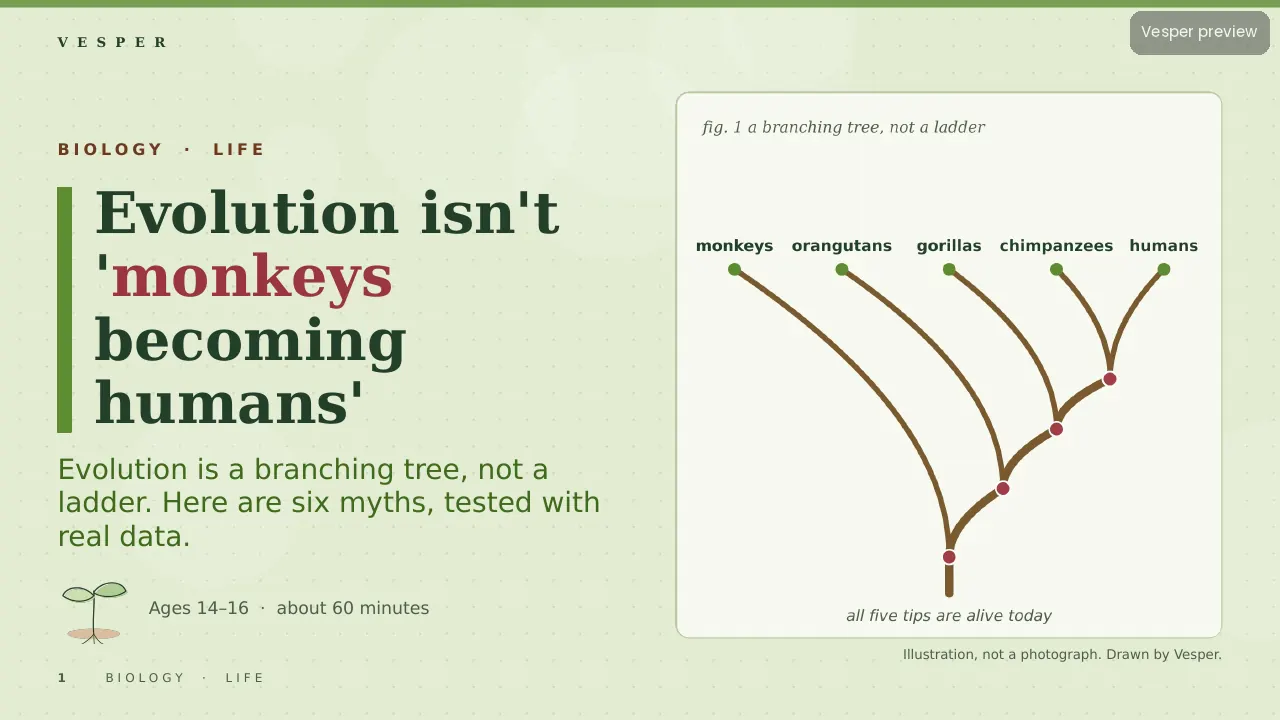
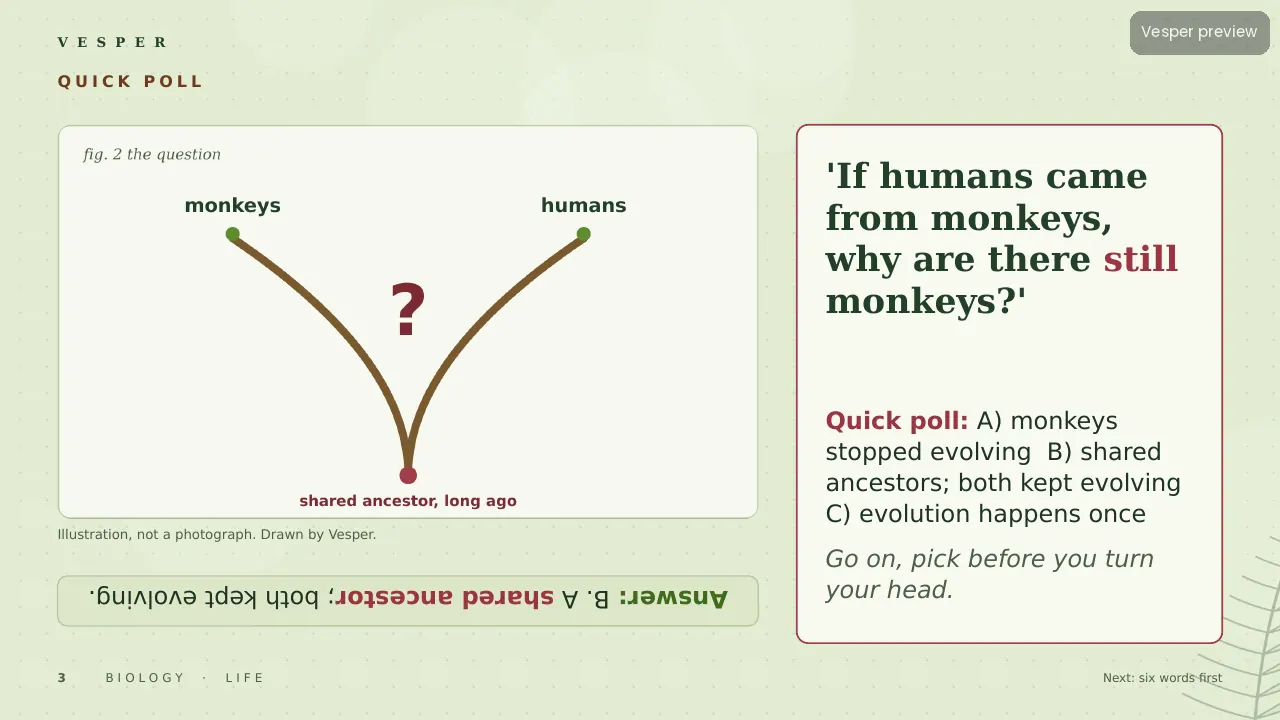
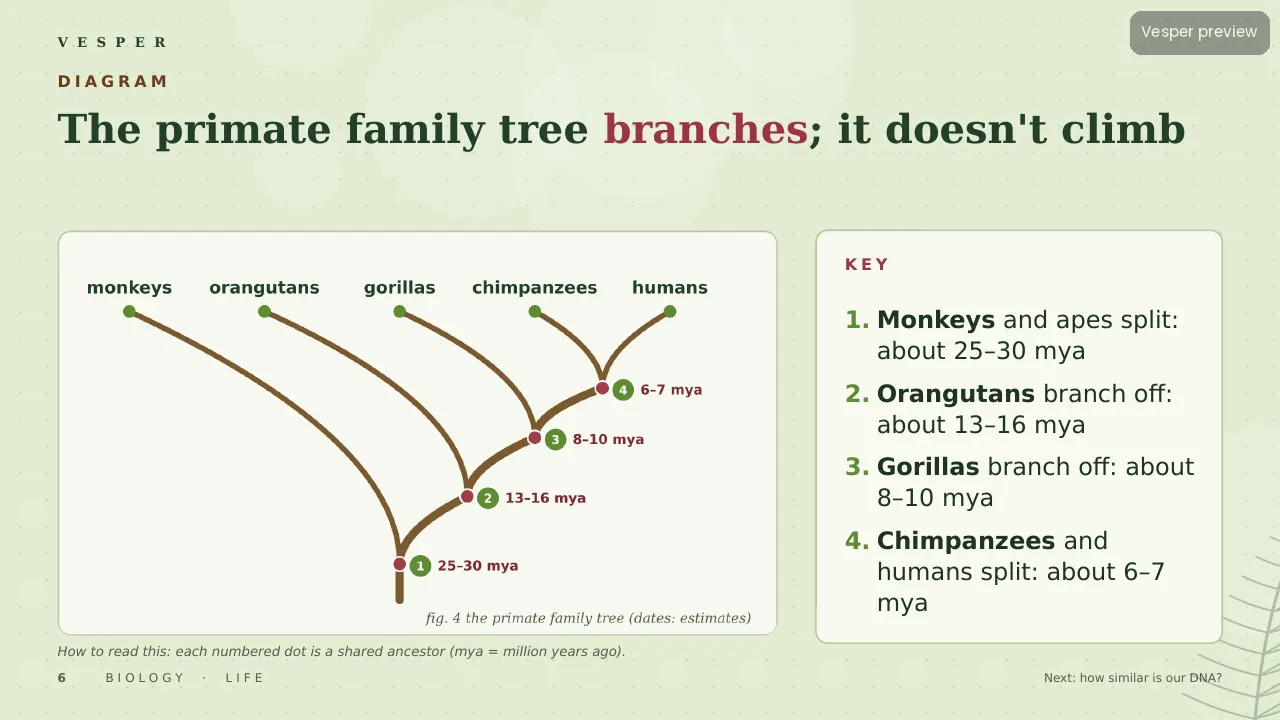
Humans did not evolve from monkeys or chimpanzees. Humans and chimps share a common ancestor that lived about 6–7 million years ago, and both lines kept evolving, like cousins who share grandparents. Evolution is a branching tree, not a ladder, so monkeys alive today are relatives on other branches, not our ancestors.

Inside the deck

slides
30
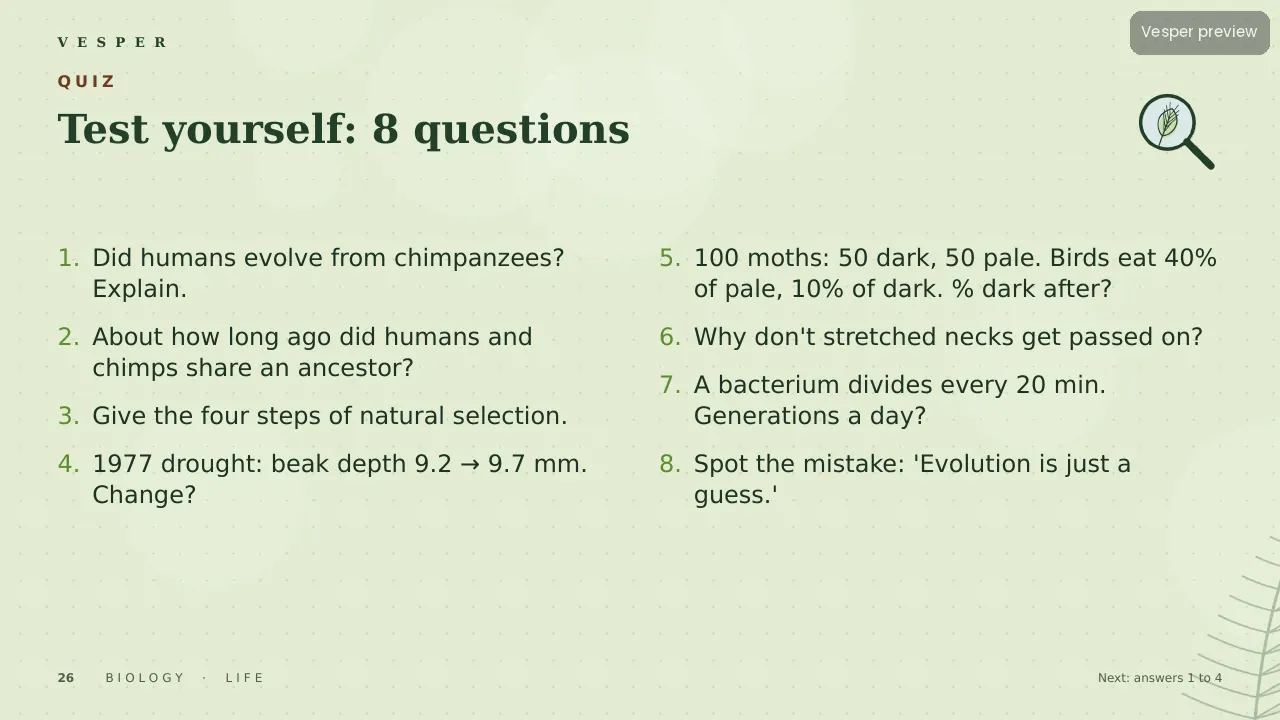
quiz questions
8
minutes
60
your-turn tasks
11

Choose a format

  • Lesson Notes (PDF)Every slide with its teacher notes, as a PDF to read or print.
  • Teacher DeckThe editable PowerPoint with speaker notes on every slide, a PDF copy and the matching Vesper slide template, so you can add slides of your own.
Pricing coming soon

Pricing coming soon

We’ll email you pricing and launch offers shortly.

  • Finished and checked: buying opens soon
  • Sources listed at the end
  • Curriculum links under ‘Curriculum & specs’
  • For one classroom. Campus licences for whole schools

Key facts

  • Humans and chimpanzees share a common ancestor about 6–7 million years ago.
  • Human and chimp DNA differ by about 1.2% in single letters (2005 genome comparison).
  • After the 1977 drought on Daphne Major, average finch beak depth went from 9.2 mm to 9.7 mm.
  • By the 1890s, about 98% of Manchester's peppered moths were dark.
  • Bacteria dividing every 20 minutes produce 72 generations in a day.

What students will be able to do

  • Students can explain why humans and chimpanzees share a common ancestor rather than one coming from the other.
  • Students can describe natural selection in four steps with real examples.
  • Students can calculate how selection shifts the make-up of a population in one generation.
  • Students can explain why acquired changes, such as stretched necks, are not inherited.
  • Students can explain why 'just a theory' misunderstands the scientific meaning of theory.

About this lesson

What students discover

‘If humans came from monkeys, why are there still monkeys?’ This lesson answers the question properly. A family analogy starts it: you share grandparents with your cousin, but you didn’t descend from your cousin. A numbered primate tree with date ranges follows, showing humans and chimpanzees sharing an ancestor about 6–7 million years ago. A 2005 genome comparison puts our single-letter DNA difference at about 1.2%.

Natural selection is set out in four steps (variation, inheritance, selection, time) and then measured. After the 1977 drought on Daphne Major, finch beaks went from 9.2 mm to 9.7 mm in one generation. Peppered moths in Manchester turned dark as soot covered the trees, with about 98% dark by the 1890s. Bacteria that divide every 20 minutes manage 72 generations a day, which is why antibiotic resistance appears so fast. After the opening question, five numbered myths fall: the ladder, giraffes stretching their necks, ‘just a theory’, ‘most evolved’ and ‘humans have stopped evolving’.

Inside the deck

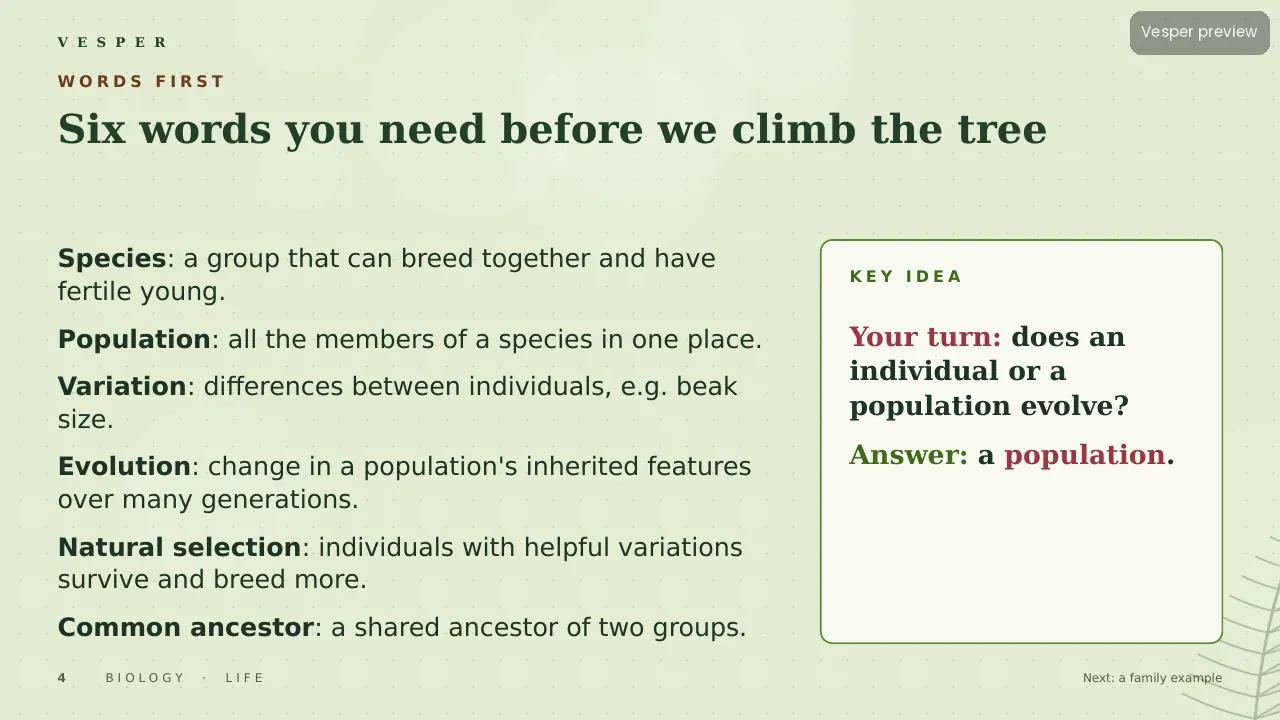
30 slides on the Field Notes template: a quick-poll hook, a six-word primer, two diagrams, four evidence slides, five myth slides, two checkpoints and a frontier slide that badges what is established and what is still debated. If Earth’s history were one day, our species arrives in the last 6 seconds. An eight-question quiz has explained answers.

How to teach it

About 60 minutes. The moth worked example (50 dark, 50 pale, birds eat 40% of pale and 10% of dark) is worth doing on the board: 60% dark after one round. Speaker notes sit on every slide.

Who it’s for

Learners aged 14–16 studying variation and selection, and teachers who want to deal with the common misconceptions head-on, using data rather than assertion.
Curriculum & specs

CBSE/NCERT (India)Class 9-10 · Not in current Class 10 book (evolution removed in 2023 rationalisation; Class 12 Biology). Link: Class 9 Exploration ch 12 Patterns in Life: Diversity and Classification
CambridgeLS Stage 9 Biology (variation, natural selection); IGCSE 0610 §18 Variation and selection
NGSS (US)MS-LS4-2; MS-LS4-4; HS-LS4-1
IB MYPSciences · KC Change · RC Evidence, Patterns
Ages14–16
LevelSenior
Slide templateField Notes
Slides30
Teaching timeAbout 60 minutes
LanguageEnglish (UK)

Questions

Questions, answered

If humans evolved from monkeys, why are there still monkeys?

Humans didn't evolve from today's monkeys. Humans and other primates share common ancestors, and every branch kept evolving.

Did humans evolve from chimpanzees?

No. Humans and chimps are cousins that share a common ancestor from about 6–7 million years ago.

What are the four steps of natural selection?

Variation, inheritance, selection and time: individuals differ, some differences are inherited, some variants survive and breed more, and over generations the population changes.

Is evolution just a theory?

In science, a theory is a well-tested explanation that fits a huge amount of evidence, not a guess.

What is an example of evolution happening today?

Bacteria evolving antibiotic resistance. Some divide every 20 minutes, so resistant variants can spread within days.

What age is this evolution lesson for?

Ages 14–16. It takes about 60 minutes and includes an eight-question quiz.

Main sources

  1. Chimpanzee Sequencing and Analysis Consortium (2005) Nature, 437, 69–87 (about 1.23% single-letter difference).
  2. Grant, P. R. and Grant, B. R.: Daphne Major finches; 1977 drought beak depths 9.2 / 9.9 / 9.7 mm (Open University OpenLearn summary, read 18 Nov 2026).
  3. Peppered moth: Kettlewell (1955); Majerus et al.; Cook et al. (2012) Biol. Lett., 8, 609–612.

The full source list is on the last slides of the deck. Spotted an error? Tell us.