Life Ages 13–15

A cell as a city: the organelle tour

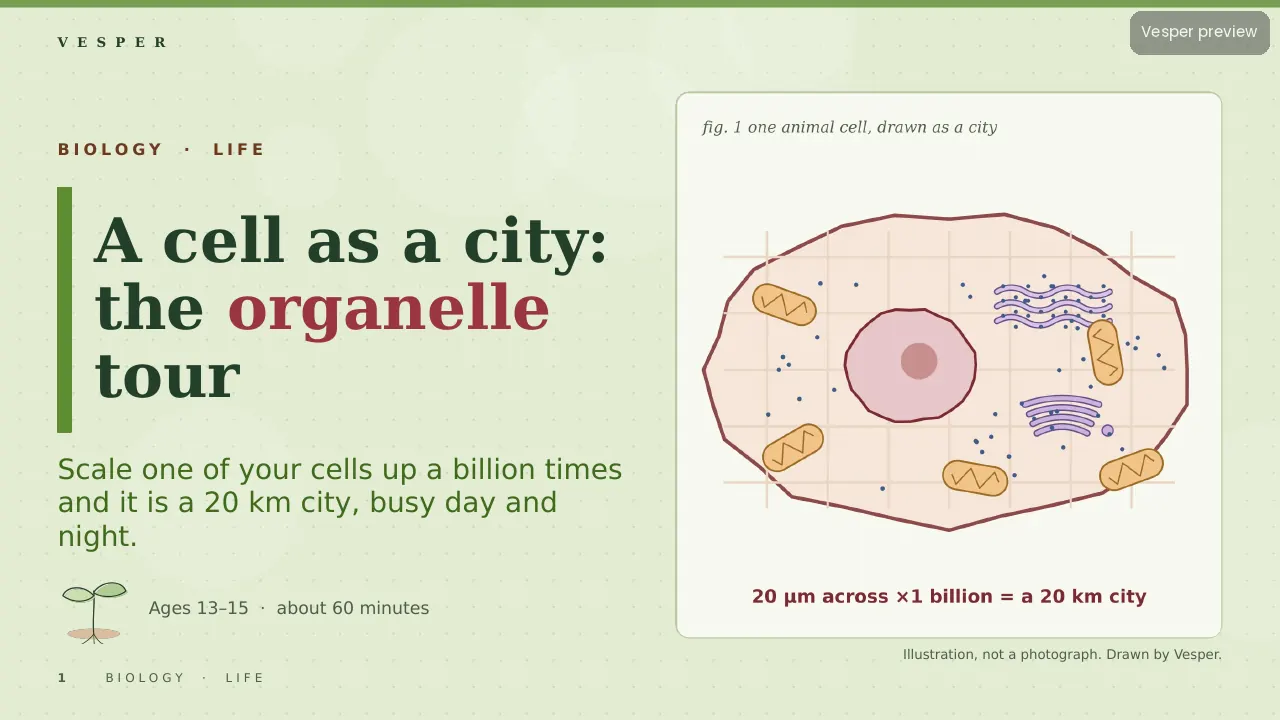
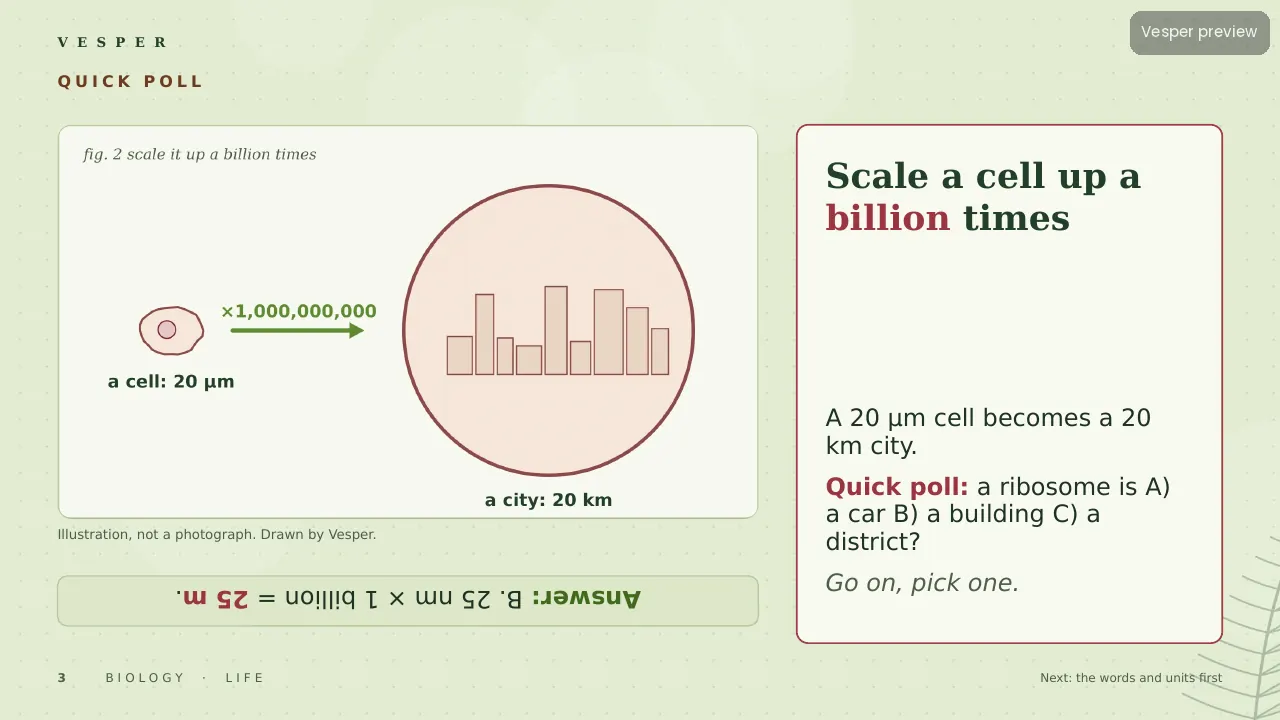
Scale one cell up a billion times and it becomes a 20 km city.

Students scale a cell up a billion times and tour it as a 20 km city, where every organelle has a job, a real size and a number. The 32 slides finish with magnification maths and a quiz.

The short answer

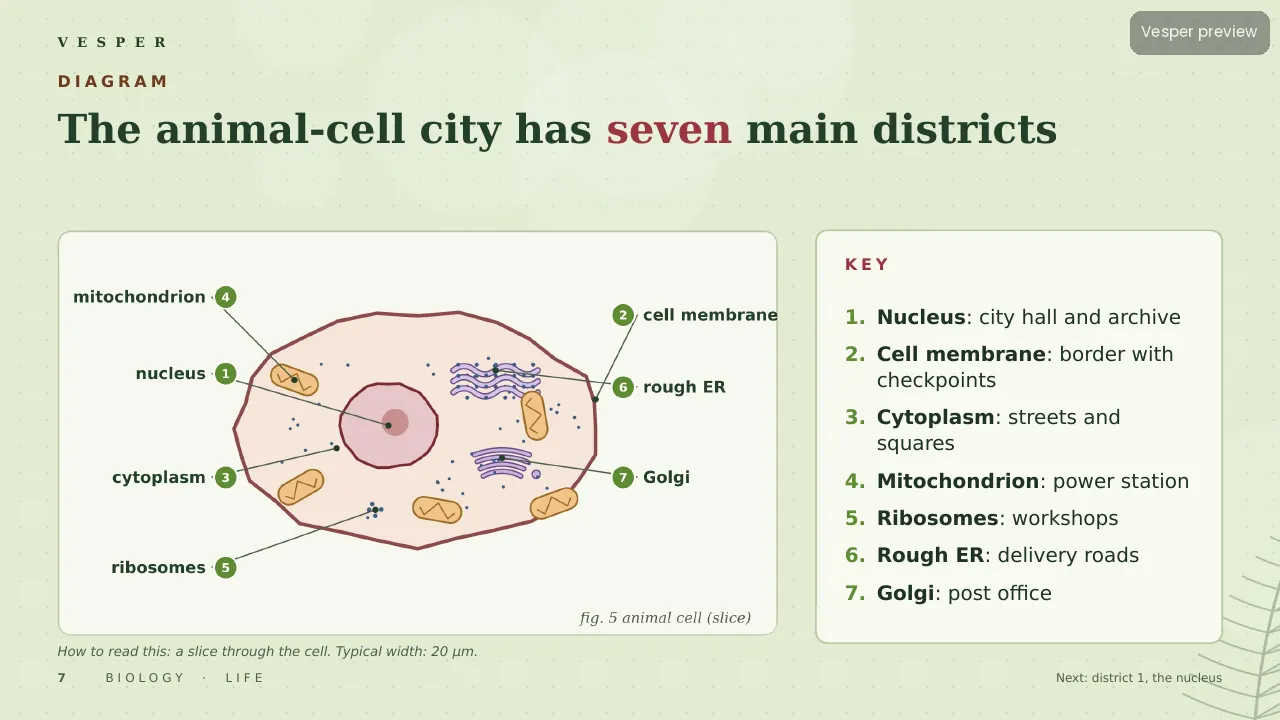
In the cell-as-a-city model, the nucleus is city hall holding the plans (about 2 m of DNA), the membrane is a border with checkpoints, mitochondria are power stations and ribosomes are workshops building proteins. Scaled up a billion times, a 20 µm cell becomes a 20 km city, and 1 µm becomes 1 km.

Inside the deck

slides
32
quiz questions
8
minutes
60
your-turn tasks
7

Choose a format

  • Lesson Notes (PDF)Every slide with its teacher notes, as a PDF to read or print.
  • Teacher DeckThe editable PowerPoint with speaker notes on every slide, a PDF copy and the matching Vesper slide template, so you can add slides of your own.
Pricing coming soon

Pricing coming soon

We’ll email you pricing and launch offers shortly.

  • Finished and checked: buying opens soon
  • Sources listed at the end
  • Curriculum links under ‘Curriculum & specs’
  • For one classroom. Campus licences for whole schools

Key facts

  • Scaled up a billion times, a 20 µm cell becomes a 20 km city: 1 µm becomes 1 km.
  • The 6 µm nucleus holds about 2 m of DNA in 46 chromosomes.
  • A ribosome is about 25 nm across; a cell has about 10 million of them.
  • A liver cell has 1,000–2,000 mitochondria.
  • Magnification = image size ÷ actual size: 30 mm ÷ 0.03 mm = ×1,000.

What students will be able to do

  • Students can name and place the main organelles of animal and plant cells.
  • Students can explain each organelle's job using the city model, and say where the model breaks down.
  • Students can follow a protein for export through ribosome, rough ER, vesicle, Golgi and membrane.
  • Students can calculate magnification, and actual size, from an image.
  • Students can explain why plant cells need both chloroplasts and mitochondria.

About this lesson

What students discover

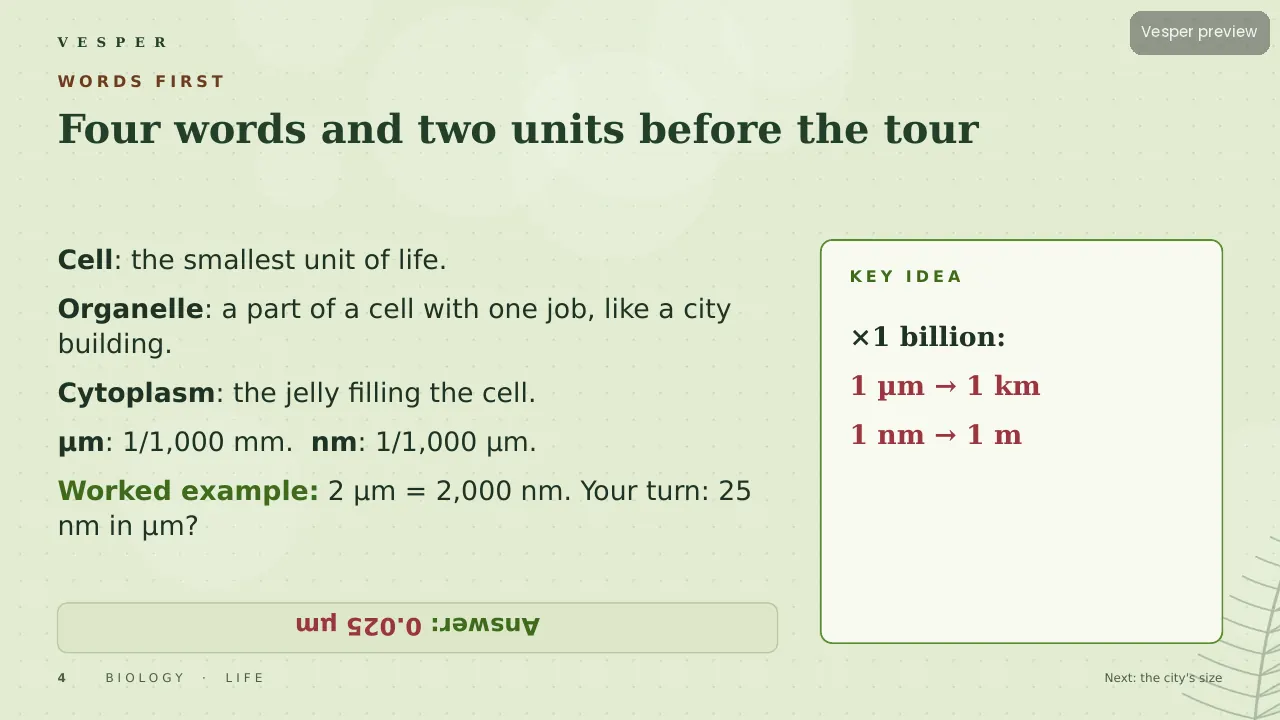
Multiply one of your cells by a billion and it becomes a 20 km city. That single trick makes every organelle concrete. The 6 µm nucleus becomes a 6 km old town holding 2 m of DNA, which at city scale stretches about 2 million km. A 25 nm ribosome becomes a 25 m building, and the 8 nm membrane becomes an 8 m city wall.

Students label animal and palisade cells on numbered diagrams, then follow a protein for export through five stops: ribosome, rough ER, vesicle, Golgi and membrane. The plant city keeps every district and adds three: a cellulose wall, chloroplasts and a large vacuole. A myth slide fixes ‘plants have chloroplasts instead of mitochondria’ (they have both). Robert Hooke’s 1665 cork cells introduce the limit of light microscopes, and two worked slides teach magnification = image ÷ actual size, and back again.

Inside the deck

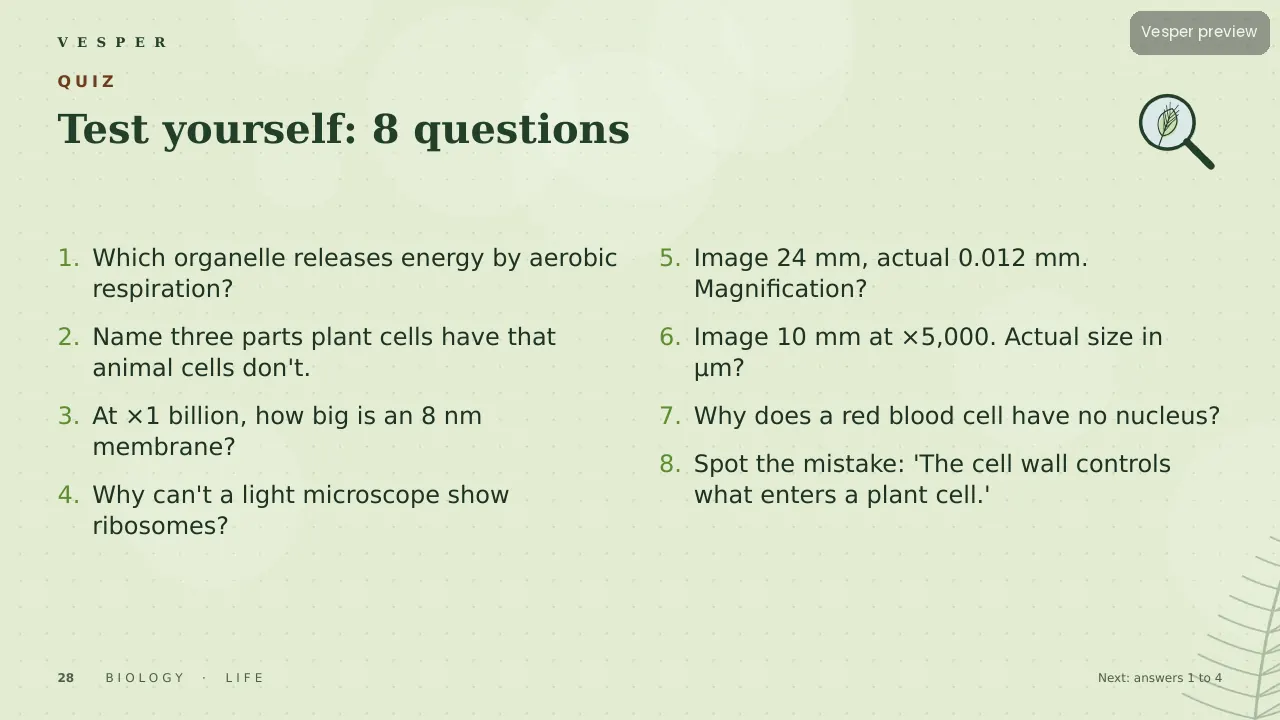
32 slides on the Field Notes template: a quick-poll hook (is a ribosome a car, a building or a district?), a primer on words and units, three diagrams, two checkpoints and seven your-turn moments. Students see where the city model breaks down, why some antibiotics jam bacterial ribosomes but not ours, and the evidence that mitochondria were once bacteria. An eight-question quiz has explained answers.

How to teach it

About 60 minutes. Keep the conversion rule on the board (µm becomes km, nm becomes m) and students can place any organelle at city scale themselves. Speaker notes cover every slide.

Who it’s for

Learners aged 13–15 meeting cell structure, and teachers who want sizes and numbers attached to every label rather than a list to memorise.
Curriculum & specs

CBSE/NCERT (India)Class 8-9 · Class 9 Exploration ch 2 Cell: The Building Block of Life
CambridgeLS Stage 7 Biology (cells); IGCSE 0610 §2 Organisation of the organism
NGSS (US)MS-LS1-1; MS-LS1-2
IB MYPSciences · KC Systems · RC Function, Models
Ages13–15
LevelSenior
Slide templateField Notes
Slides32
Teaching timeAbout 60 minutes
LanguageEnglish (UK)

Questions

Questions, answered

What is the cell as a city analogy?

Each organelle plays a city role: the nucleus is city hall with the plans, mitochondria are power stations, ribosomes are workshops, the Golgi is the post office and the membrane is the border.

What are the main organelles in an animal cell?

Nucleus, cell membrane, cytoplasm, mitochondria, ribosomes, endoplasmic reticulum and Golgi apparatus; lysosomes recycle worn-out parts.

What do plant cells have that animal cells don't?

A cellulose cell wall, chloroplasts and a large permanent vacuole. They also keep everything an animal cell has, including mitochondria.

How do you calculate magnification?

Divide the image size by the actual size, in the same units. An image of 24 mm of a cell 0.012 mm long is ×2,000.

Why can't a light microscope show ribosomes?

Ribosomes are about 25 nm across, far below the roughly 200 nm limit of a light microscope.

What age is this cell lesson for?

Ages 13–15, about 60 minutes, with an eight-question quiz and explained answers.

Main sources

  1. Alberts, B. et al. (2022) Molecular Biology of the Cell, 7th edn. Norton (organelles, sizes, mitochondria per liver cell).
  2. Milo, R. and Phillips, R. (2016) Cell Biology by the Numbers. Garland; BioNumbers database, Harvard (HeLa: about 9.5 million ribosomes, ID 107347).
  3. Hooke, R. (1665) Micrographia. London.

The full source list is on the last slides of the deck. Spotted an error? Tell us.