Cosmos Ages 13+

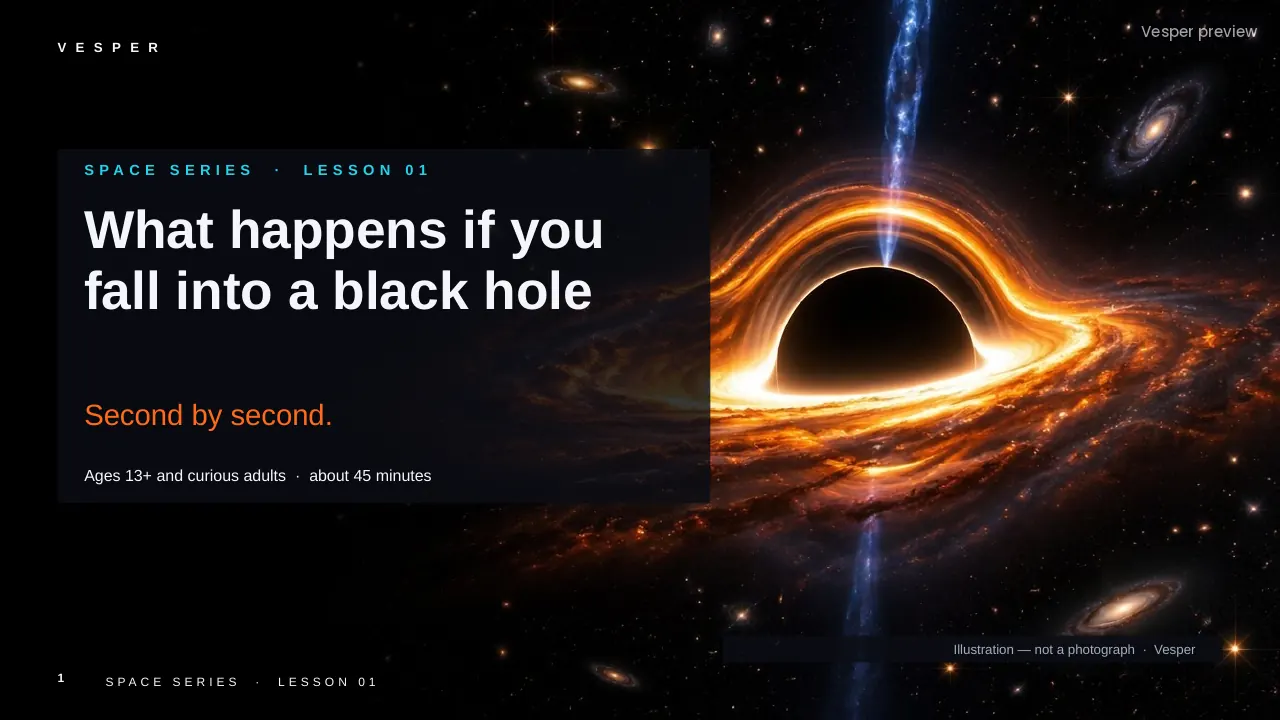
What happens if you fall into a black hole, second by second

You fall. Your friend watches. Both stories are true.

Follow one imaginary fall into a black hole, from the first tug of gravity to the singularity, while a friend watches from orbit. Then see how we know black holes are real, with the Event Horizon Telescope images of M87* and Sgr A*.

The short answer

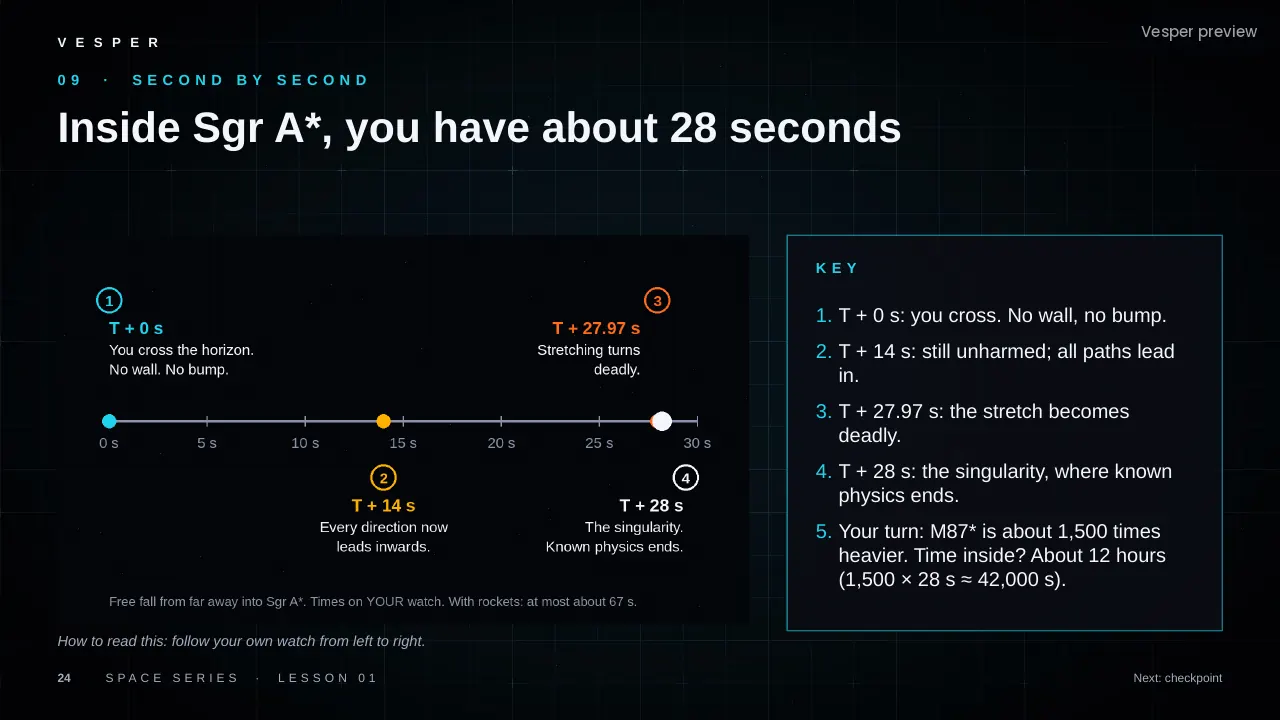
A small black hole would stretch you apart before you reached its edge. A giant one such as Sgr A* is gentle at the horizon: you cross unharmed and reach the centre about 28 seconds later on your own watch, while a friend in orbit sees you slow, redden and fade, never quite crossing.

Inside the deck

slides
45
quiz questions
8
minutes
45
your-turn tasks
4

Plenty to extend into a second lesson (about 99 minutes of activities in the notes).

Choose a format

  • Lesson Notes (PDF)Every slide with its teacher notes, as a PDF to read or print.
  • Teacher DeckThe editable PowerPoint with speaker notes on every slide, a PDF copy and the matching Vesper slide template, so you can add slides of your own.
Pricing coming soon

Pricing coming soon

We’ll email you pricing and launch offers shortly.

  • Finished and checked: buying opens soon
  • Sources listed at the end
  • Curriculum links under ‘Curriculum & specs’
  • For one classroom. Campus licences for whole schools

Key facts

  • Squeeze Earth into a ball 9 mm across and it would become a black hole
  • The horizon radius grows by about 3 km for every Sun of mass
  • Near a 10-Sun black hole, your feet are pulled about 540 g harder than your head
  • Inside Sgr A*, about 28 seconds pass on your watch from horizon to centre
  • LIGO heard two black holes of 36 and 29 Suns merge on 14 September 2015
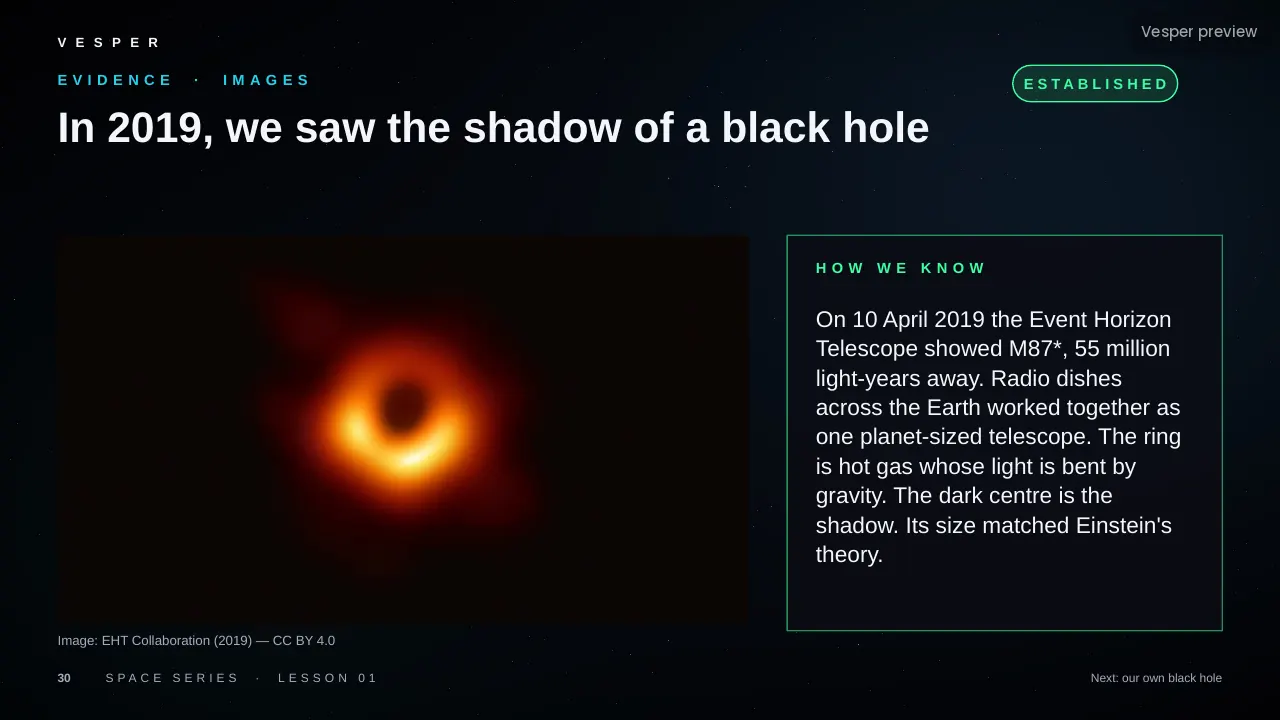
  • Real Event Horizon Telescope images of M87* (2019) and Sgr A* (2022)

What students will be able to do

  • Students can explain a black hole as a place where escape speed is greater than the speed of light
  • Students can explain why small black holes stretch you apart and giant ones do not
  • Students can explain why a watching friend sees you freeze while you fall straight through
  • Students can name three kinds of evidence that black holes are real
  • Students can say which black hole questions are still unanswered

About this lesson

What students discover

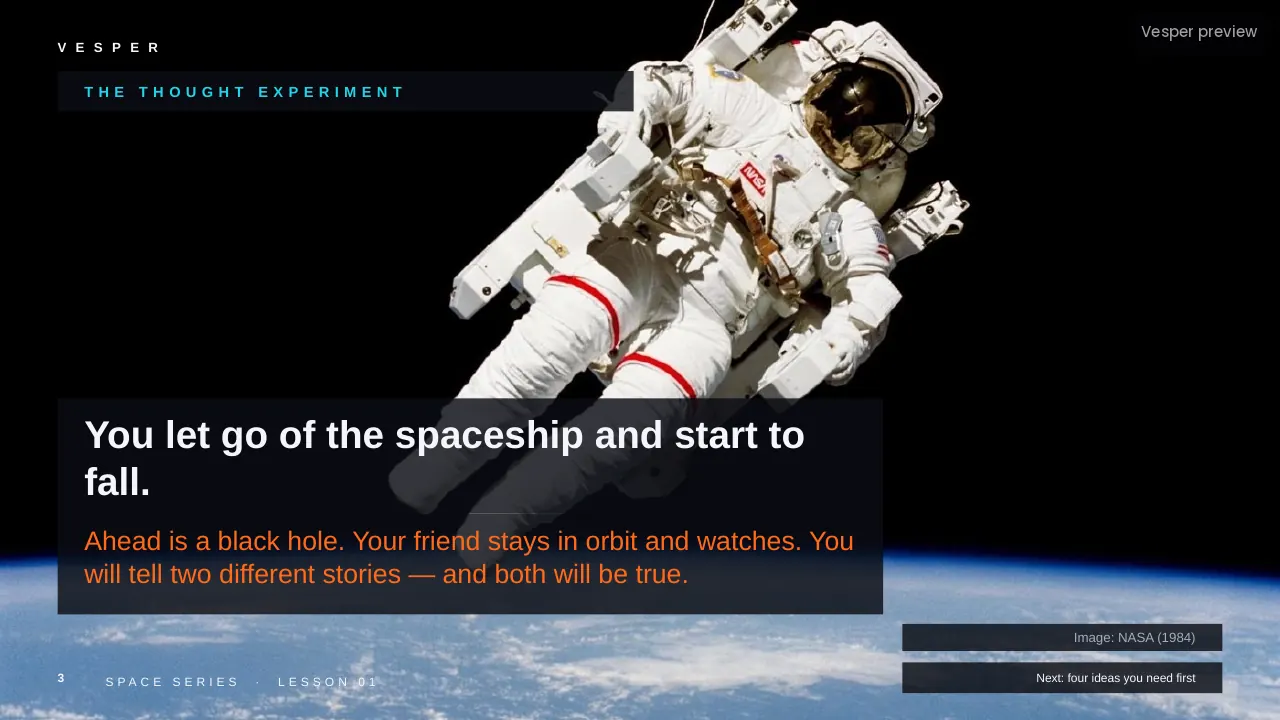
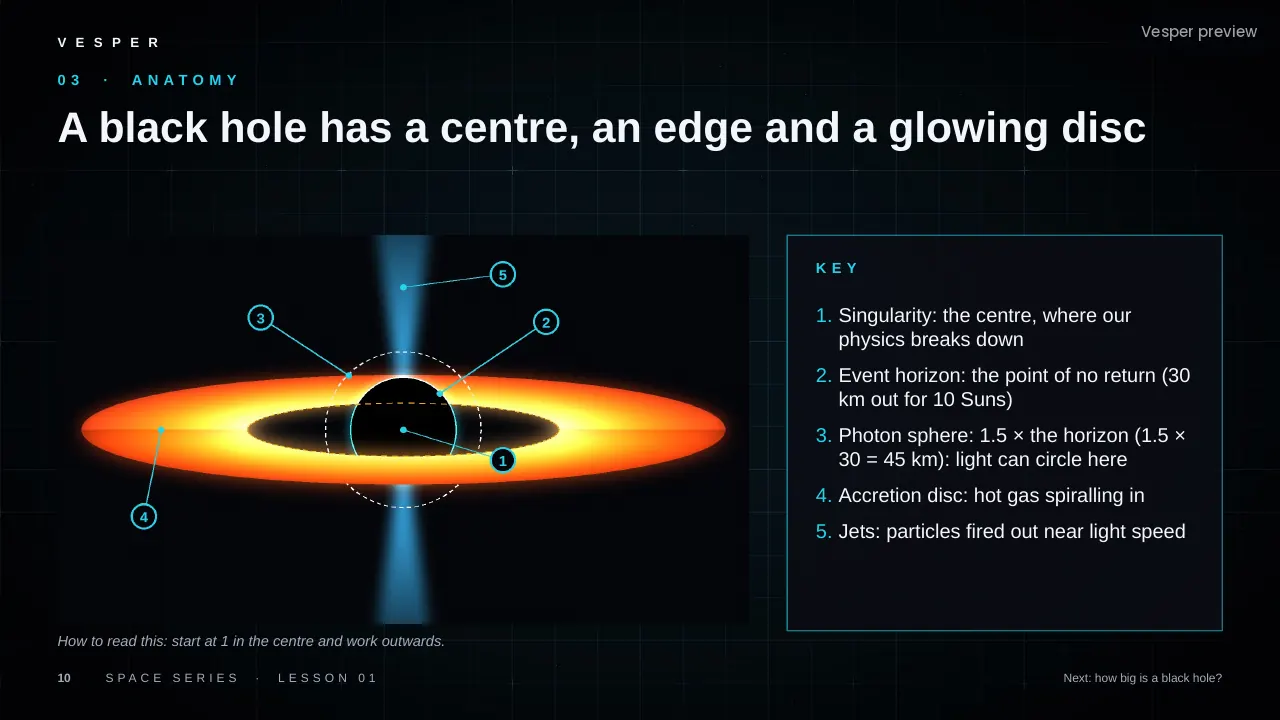
You let go of the spaceship and start to fall. Your friend stays in orbit and watches. Students tell both stories, and both turn out to be true. First they build the idea from four basics: gravity, escape speed (11.2 km/s from Earth), the speed of light and the Sun as a ruler. A black hole is where escape speed beats light; squeeze Earth into a ball 9 mm across and it would become one.

Then the fall. Near a black hole of 10 Suns, your feet are pulled about 540 g harder than your head, so tidal forces pull you apart long before the horizon. At Sgr A*, the stretch at the horizon is about one ten-thousandth of Earth’s gravity. Gravity also slows time: satellite-navigation clocks gain 38 millionths of a second a day, so your friend sees you slow, redden and fade while your own watch ticks on. Inside, every path leads to the centre, about 28 seconds away.

Inside the deck

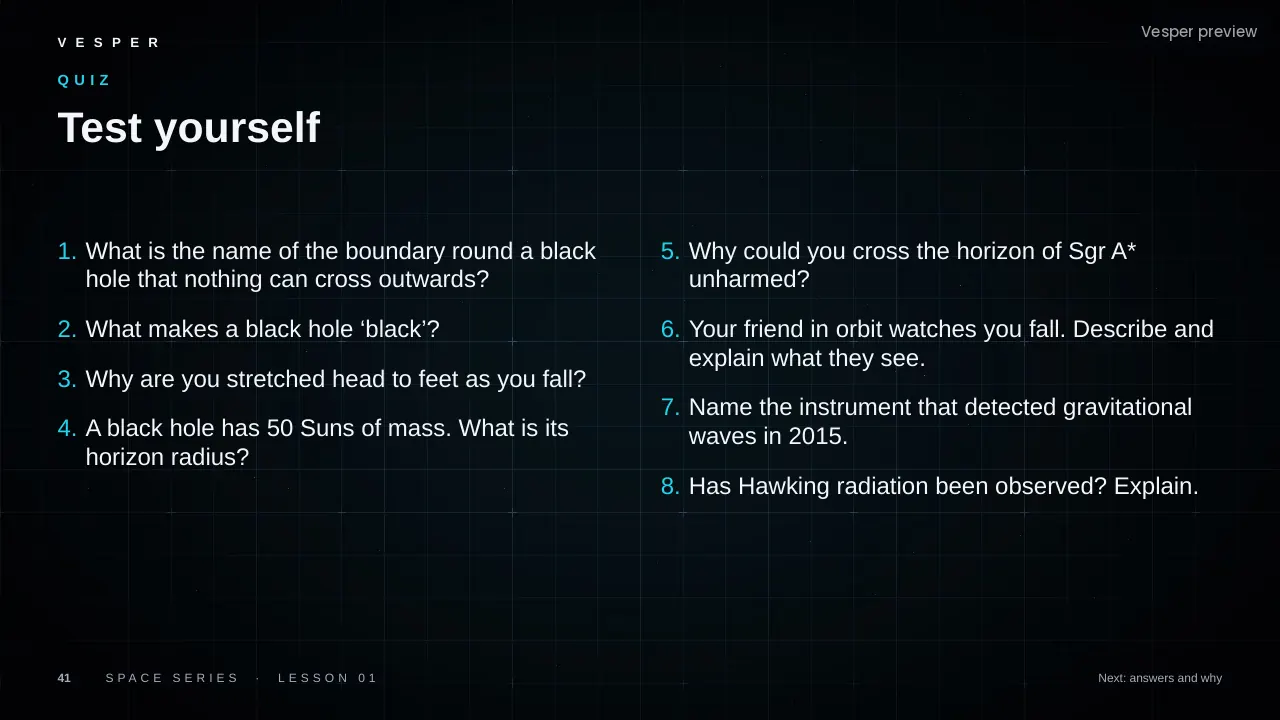
45 slides that a student can also read alone. A primer, a 236-year timeline from Michell’s dark stars to the first image of a black hole, two myth busters, four checkpoints and four your-turn calculations with answers. The evidence is real: stars racing round Sgr A*, LIGO’s 2015 gravitational waves, and the Event Horizon Telescope images of 2019 and 2022. The open questions are clearly badged as hypothesis or not yet observed. A glossary, an 8-question quiz with explained answers, sources and full image credits close the lesson.

How to teach it

The cover says about 45 minutes. Keep the two stories side by side and pause at slide 21, the heart of the lesson. Let students predict before each reveal, and keep illustrations and real images apart: every slide is labelled. Notes on every slide give Say, Ask, Watch for and Time.

Who it’s for

For ages 13+ and curious adults, and a strong enrichment lesson on gravity, light and how science tests an idea. Editable PowerPoint built on the Vesper slide master, with a PDF copy.
Curriculum & specs

CBSE/NCERT (India)Class 9–10 · No direct chapter (enrichment). Nearest: Class 9 Exploration ch 6 How Forces Affect Motion (gravity)
CambridgeIGCSE Physics 0625 §6.2 Stars and the Universe
NGSS (US)HS-ESS1-1; HS-PS2-4
IB MYPSciences · KC Change · RC Energy, Models · Crit A, D
Common Core (US)8.EE.A.4 (scientific notation)
Ages13+
LevelSenior
Slide templateNova
Slides45
Teaching timeAbout 45 minutes
LanguageEnglish (UK)

Questions

Questions, answered

What happens if you fall into a black hole?

Near a small black hole, tidal forces stretch you apart before you reach the horizon. At a giant one you cross the horizon unharmed, then every path leads to the centre within seconds.

What is spaghettification?

Stretching by tidal forces: gravity pulls your feet harder than your head, so you are stretched from head to feet and squeezed from the sides. Astronomers really use the word.

Would you feel anything crossing the event horizon?

Not at a giant black hole. At Sgr A*, the stretch across your body at the horizon is about one ten-thousandth of Earth's gravity, so you would not notice it.

How long would you survive inside a black hole?

Falling into Sgr A*, about 28 seconds pass on your watch between the horizon and the centre. M87* is about 1,500 times heavier, which gives about 12 hours.

Do black holes suck in everything around them?

No. From far away a black hole pulls like any object of the same mass. The star S2 has circled Sgr A* every 16 years without falling in.

Is the Event Horizon Telescope image a photograph of a black hole?

It shows glowing gas and the dark shadow the black hole casts. A black hole gives out no light, and the shadow is about 2.5 times wider than the horizon.

Main sources

  1. Michell, J. (1784). On the means of discovering the distance, magnitude, &c. of the fixed stars. Philosophical Transactions of the Royal Society 74, 35–57.
  2. Schwarzschild, K. (1916). Über das Gravitationsfeld eines Massenpunktes nach der Einsteinschen Theorie. Sitzungsberichte der Preussischen Akademie der Wissenschaften, 189–196.
  3. Hawking, S. W. (1974). Black hole explosions? Nature 248, 30–31.

The full source list is on the last slides of the deck. Spotted an error? Tell us.